Ozark Furnace
Profile view of a bearded man wearing a dark baseball cap and a dark gray T-shirt against a plain off-white background.

How long a furnace lasts in Arkansas

Step 1 of 3: Equipment

How long does a furnace last in Arkansas?

You're probably asking because your furnace is getting up there in age, or it just started acting up and you're wondering if it's worth fixing or replacing. Most homes in Arkansas lean on electric heat rather than gas, and that changes what "normal wear" looks like for the system keeping your family warm on the colder nights.

15 to 20 years, often longer for electric furnaces

A furnace typically lasts 15 to 20 years, and electric furnaces, which most Arkansas homes use, tend to land on the longer end of that range since they have no burner or heat exchanger to wear out over time. The parts that fail first are usually the blower motor and the heating elements, not the cabinet itself. Since winters here are milder than in a lot of the country, your furnace isn't running as hard or as long each year as it would further north, which also stretches its working life. Once it passes 20 years, parts get harder to find, and a repair bill on an old unit is worth weighing against replacing it.

A dimly lit interior with wood plank flooring where a small portable heater with a glowing orange element sits near an open doorway, with a stove at left, kitchen cabinets and a potted plant at right, and a wooden table and chair in the foreground.

Six-thirty, and the kitchen is cold enough that you plugged in the space heater again. It ticks and glows orange by the table while you wait on coffee. Behind you the basement door is open, the way you left it last night checking on the furnace. It kicked on fine then. Now you're not so sure, since the air coming through the vent upstairs feels no warmer than the house itself. Your kid is at the table in a sweatshirt, hands wrapped around a mug, not saying anything about it, just leaning toward the heater a little. Outside it's still dark. You're doing the math on how many mornings like this you've had this month, and whether that number means something.


Is your furnace trying to tell you something?

You notice it in small ways first. The furnace runs longer than it used to before the house feels warm. It clicks a few times before it catches, where it used to light right away. Some rooms stay cooler than others no matter how high you set the thermostat. Maybe there's a burnt smell the first few times it fires up for the season, or a rattle from the cabinet that wasn't there last year. On its own, any one of these might be nothing. Together, they usually mean the furnace is working harder to do what it used to do easily. Left alone, that strain tends to end in a bigger repair bill, or heat going out on the coldest night of the year.

A gray high-efficiency furnace in a basement with white PVC vent pipes, sheet-metal ductwork, copper and black piping, a condensate pump, and insulated walls above a concrete floor.

Running the way it should

This is a furnace doing its job. The ductwork carries warm air to the rooms, the drain line clears condensation as it burns, and nothing around it needs a second look. A furnace in this shape just gets asked to heat the house, nothing more.

A beige residential furnace stands on a concrete basement floor beside galvanized sheet-metal ductwork, a round flue pipe, copper gas piping, and a PVC condensate line, with a wood-paneled wall at right.

Running, but working harder to do it

This furnace still lights and still heats, but it's been down there a long time. The grime on the panels, the older flue, the ductwork original to the house. None of that means it's about to quit, but it's the kind of unit worth having looked at before it decides to quit on its own.

A gray furnace with two access panels stands on a concrete basement floor beside sheet-metal ductwork, with pipes, flexible conduit and an electrical box on the concrete wall to the left.
Before you get your furnace installation
A gray high-efficiency furnace stands on a concrete basement floor beside galvanized sheet-metal ductwork, white PVC vent pipes, copper and black piping, and unfinished wood stud framing.
After you get your furnace installation
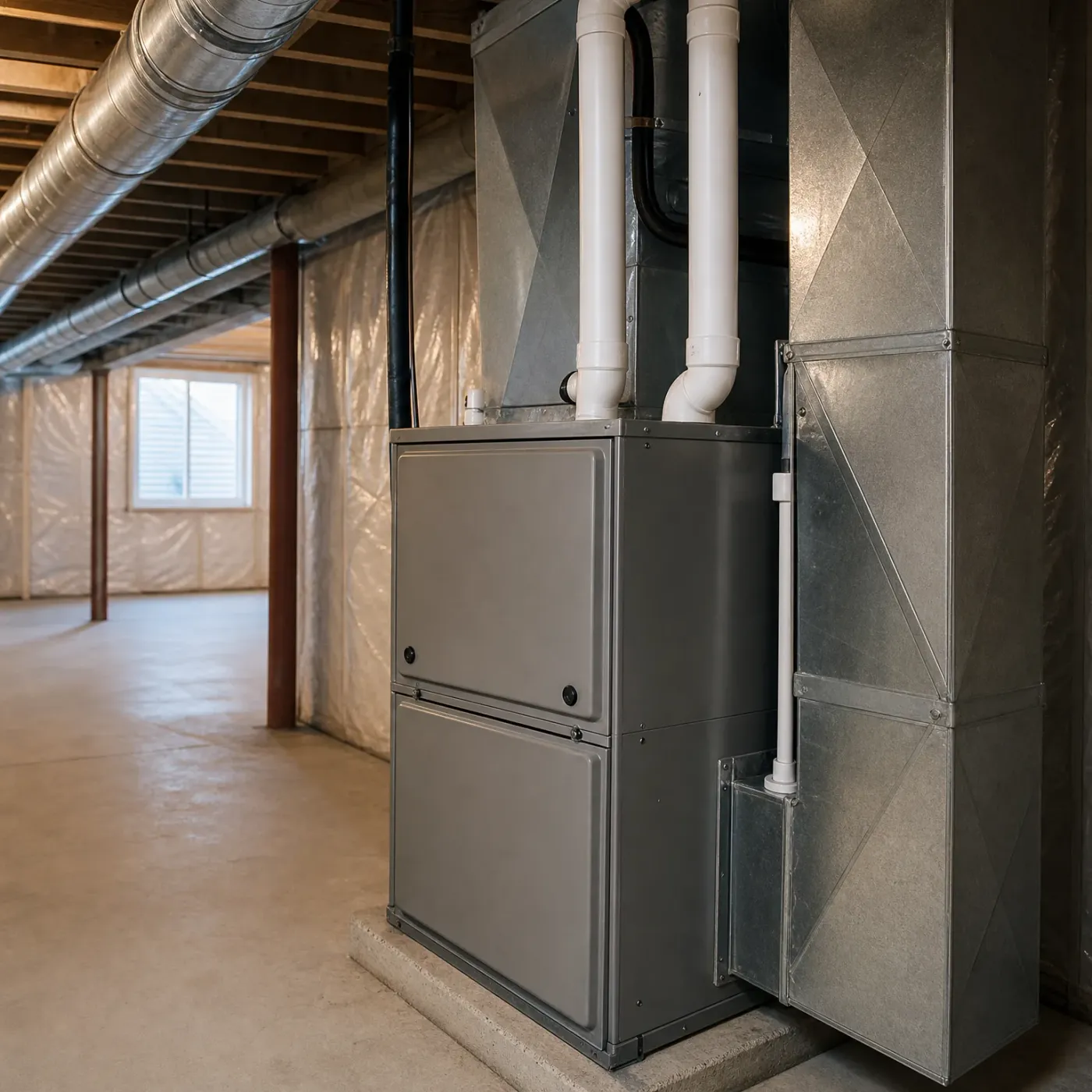
A gray high-efficiency furnace on a concrete pad in an unfinished basement, with white PVC vent pipes, galvanized sheet-metal ductwork, insulated walls and a small window in the background.

A local pro for your furnace installation

One installer gets your project, so there's no bidding war over it.

Get in touch with a local installer about a new furnace.

Find a local pro

Asking costs nothing, and the choice to hire stays yours.

A woman in a cream sweater and jeans stands in the open doorway of a white stucco house, holding the dark door, while a man in a dark quilted jacket seen from behind walks toward the entry past potted plants.

What happens inside when it fires up

A furnace doesn't just flip on. The thermostat calls for heat, the inducer motor starts pulling air through to clear the chamber, and only then does the igniter glow hot enough to light the gas. The burners come on, the heat exchanger warms up, and once it reaches temperature the blower kicks in to push that warm air through the ducts. Each step waits on the one before it. If the inducer doesn't prove it's running, the igniter never gets a signal, and you get a furnace that just clicks and quits.

Every one of those steps is a part that wears differently depending on how the system was set up and how hard it runs. A furnace sized wrong for the house, or installed without enough return air, works harder on every single cycle than one set up right from the start. Someone who installs furnaces in Arkansas every week knows the install mistakes that shorten a system's life before it ever has the chance to prove itself, and a local licensed contractor matched to your house is the one who can tell you if yours was set up to last.

Interior corner of a living room with a beige upholstered sofa and dark cushion in the foreground, a ceramic vase of leafy branches on a dark side table by a curtained window, a framed picture on the wall, and a wood-surround fireplace at right.
A gray high-efficiency furnace with white PVC vent pipes stands beside sheet-metal ductwork and a water heater in an unfinished basement with concrete walls and wood framing.

A furnace still earning its keep

This one sits clean in an unfinished basement, flue pipes tight and ductwork sound overhead. It fires when asked and heats the house without drama. Gas furnaces like this can run for years past their install date if nothing around them is neglected.

A beige gas furnace with a metal flue pipe stands in a basement against concrete block walls, beside sheet-metal ductwork, copper and white plastic pipes, and a water heater at right.

A furnace on borrowed time

This one shares a tight utility space with galvanized ductwork and aging pipe runs around it. Furnaces in settings like this often show their age first in the burners or the heat exchanger. Once a furnace this old needs a repair, it's worth asking what else is close behind it.

A woman with dark hair in a bun wearing a cream knit sweater sits on a gray sofa in a bright living room, looking off to the side.
A woman wrapped in a knit blanket sits on a gray sofa in a living room, looking toward a bright window with houseplants and an armchair in the background.
A woman in a gray cowl-neck sweater sits on a light sofa with cushions, smiling and looking to the side, with a kitchen and window visible behind her.
A woman with dark hair in a bun, wearing a light linen shirt, sits on a sofa and looks to the side, with a window, houseplants and a kitchen with pendant lights blurred behind her.

Most furnaces in Arkansas are electric, and an electric furnace has no burners, no igniter and no flue to corrode over the years.

That's one less set of parts to fail, but the blower motor and heat strips still wear with every winter they run, same as any furnace does.

Winter nights average 32°F statewide

32°F is the average overnight low here from December through February, so your furnace isn't fighting single-digit cold most nights, just steady chilly air for months at a stretch. That's long, moderate runtime, which wears heat strips and the blower gradually rather than all at once.

NOAA nClimDiv 1991-2020 county normals weighted by homes

A furnace in Arkansas lasts about as long as the national average, maybe a little longer if it's electric, since there's no burner or flue to corrode and the winters here don't ask much of it. What shortens that life is steady use over the years, the blower and heat strips cycling through mild, chilly stretches for months at a time rather than any hard freeze. Fifteen to twenty years is a reasonable run for most of these systems, less if something's been struggling for a while, more if it's been looked after. If yours is getting close to that mark, or already past it and showing signs, the honest question isn't whether it'll fail but when, and whether you'd rather choose the timing yourself. A local contractor who works on these systems all winter can tell you quickly which one you're dealing with, one you can still get another winter or two from, or one worth replacing now before it picks the coldest night to quit.

A smiling older woman with gray hair in a cream knit sweater stands in a dimly lit kitchen beside a window showing snow outside, with a round loaf of bread on the counter in the foreground.
A woman with dark hair in a bun sits wrapped in a chunky knit blanket on a couch with a child resting his head on her shoulder, eyes closed, beside a lit lamp and bookshelf indoors.

Get the right pro for your furnace

When yours is old enough to worry about, the question is whether to fix it again or put in a new one. A local contractor who installs furnaces in Arkansas every winter knows what tends to go first in homes here, electric or gas, and can tell you straight whether yours is worth another repair. You'd be matched with one contractor, not several, so you're dealing with one call back, not a pile of them.

Get a licensed local pro

The pro who reaches out is licensed in Arkansas.

No fee to send it, and nothing to sign.