







What temperature to set the heat in an Arkansas winter

A local pro who services furnaces gets in touch about the tune-up.

Find my pro

Most people in Arkansas do well setting the furnace to 68 during the day and letting it drop to around 62 overnight. That holds the house steady without making the furnace work harder than it needs to. Winters here swing, a cold snap can drop temperatures fast after a mild stretch, and a furnace left too low has to catch up all at once. Since most homes here heat with electricity, the cost of running it a degree or two warmer is small, so there's little reason to keep it lower than you're comfortable with. What matters more than the exact number is consistency. A furnace that cycles on and off gently through the day runs easier than one forced to recover from a big swing. If a room runs cold no matter the setting, or the furnace seems to run longer than it used to, that's usually a sign something needs a look before the next cold snap, not a reason to push the thermostat higher.

An older woman with gray hair in a cream knit sweater sits under a blanket on a sofa by a window, looking outside toward yellow-leaved trees, with a lamp, shelves and an armchair in the room behind her.
A gray-haired woman in a chunky knit sweater sits in an armchair with a blanket, looking out a window at yellow autumn foliage, with bookshelves and a potted plant behind her.
A gray-haired woman in a navy sweater sits in an armchair with a knit blanket beside a window, looking out at yellow autumn foliage, with a dining table and houseplant in the room behind her.
A gray-haired woman in a gray cowl-neck sweater sits in an armchair with a blanket, looking out a dark-framed window toward yellow autumn trees.
A gray high-efficiency furnace in a basement with PVC vent pipes, sheet-metal ductwork, copper and insulated pipes, a water heater at left, and an unfinished wood-stud wall at right.
A furnace running a steady, moderate setpoint cycles on and off evenly, which is what keeps the burner and igniter lasting.
An older beige furnace with louvered front panels stands on a concrete basement floor beside galvanized ductwork, metal and plastic pipes, exposed wood framing, and a cylindrical water heater at right.
A furnace pushed to cover wide swings strains harder each cycle, and that wear shows up first in the burner and heat exchanger.

Steady setpoint or wide swings

Steady setpoint

  • You pick one number, say 68, and leave it there through the day and night with maybe a few degrees of drop built in.
  • The furnace cycles on and off in short, even bursts because it is only ever closing a small gap between the air and the setpoint.
  • Rooms stay close to the same temperature whether it is 3 in the afternoon or 3 in the morning.
  • The burner and igniter see the same load cycle after cycle, which is the pattern they are built to handle.
  • You do not have to think about the thermostat once it is set, even when a cold snap comes through.

Wide swings

  • You drop the heat well down when the house is empty or everyone is asleep, then push it back up later.
  • Closing a 10 or 15 degree gap means the furnace runs longer and harder to catch the house back up.
  • The heat exchanger takes more strain working through a big swing than it does holding a steady line.
  • Rooms farthest from the furnace lag behind during the catch-up period, so they feel colder longer.
  • A technician who services furnaces all winter in Arkansas sees this pattern show up first as burner and ignition wear.
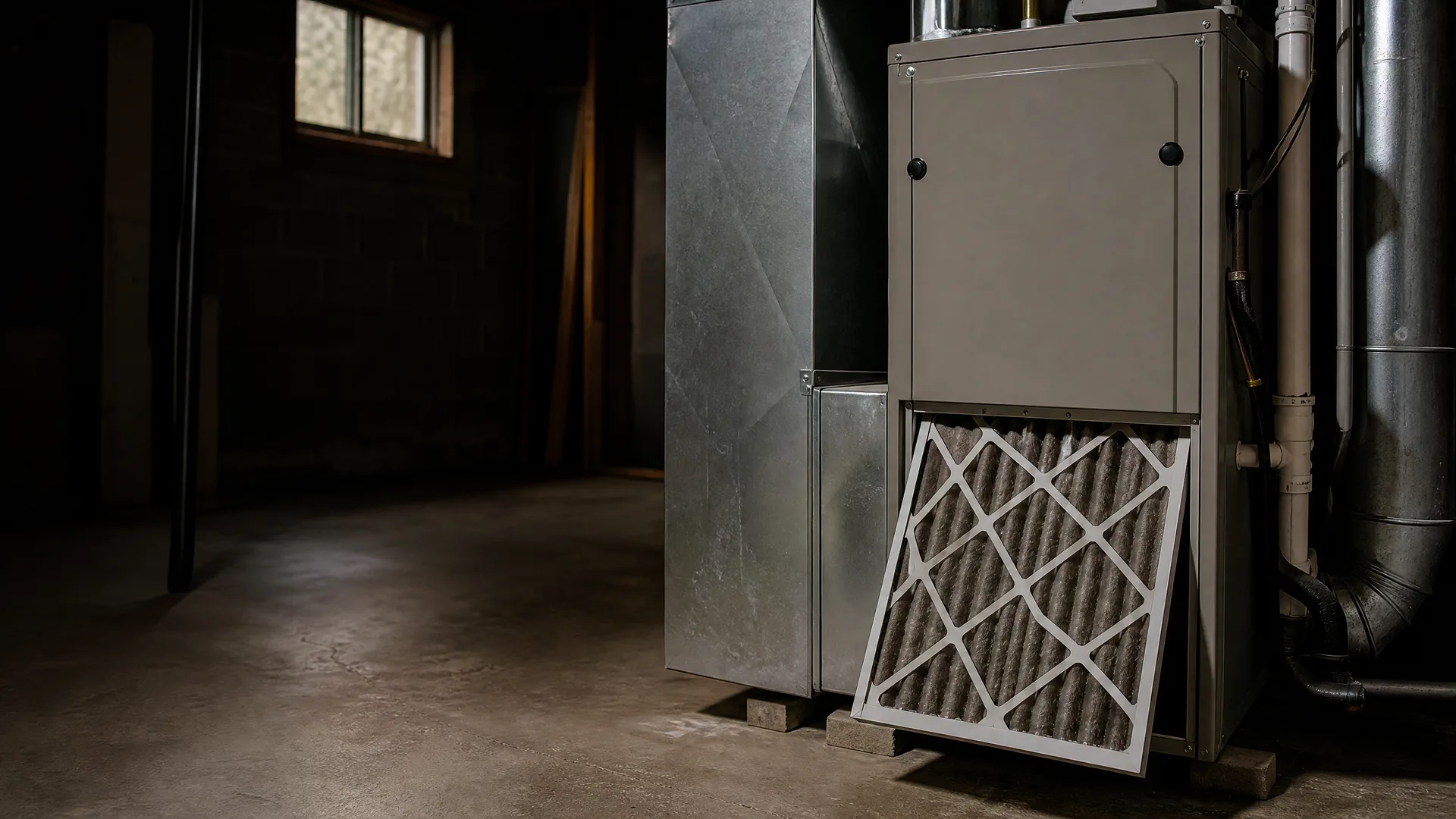
A gray furnace with sheet-metal ductwork in a dim basement, with a dirty pleated air filter leaning against its base on a concrete floor.

You're down in the basement on an October afternoon, and you've pulled the filter to check it before the first real cold hits. It slides out grey, dust caked across the pleats, the kind you can't see through anymore. You run a thumb along the edge and dust comes off on your skin. The furnace sits open behind you, waiting. You think about the thermostat upstairs, set to 68 since last week, and wonder how hard the burner's had to work pulling air through that. You set the old filter on the concrete floor and go looking for the box of new ones you bought last spring and never opened.

Winter nights average 32°F statewide

That 32°F average is the overnight low, not the daytime one, and it's an average across the whole season, so plenty of nights sit colder than that. A furnace sized to hold 62 overnight against a typical night is still working against the harder nights, which is part of why a fall checkup matters.

NOAA nClimDiv 1991-2020 county normals weighted by homes

A gray high-efficiency furnace with white PVC venting pipes stands on blocks in a basement next to sheet-metal ductwork, with exposed wood framing on the left and a concrete wall and floor.

Furnace running clean

This is what a furnace should look like going into winter. The burner lights on the first call, the cabinet is free of soot, and the ductwork off the side carries even heat to every room. A furnace kept up like this holds whatever setpoint you give it without extra cycling.


An older gas furnace with two white PVC vent pipes stands on a concrete basement floor beside galvanized sheet-metal ductwork, flexible conduit, and piping along a wall.

Furnace under strain

An older furnace like this one has usually seen its share of winters without a close look in between. The cabinet shows its age, the gas line and flue have been fitted and refitted, and a furnace in this shape struggles to hold a steady temperature, especially once the nights turn hard.

A woman in a cream knit sweater sits in an armchair with her eyes closed near a window showing yellow autumn foliage, with a mug on a round wooden side table beside her.
A gray-haired man with a beard in a blue button-placket shirt reclines on a couch with his eyes closed, beside a sunlit window with a green plant.

Matched to your furnace job

A setpoint only holds steady if the furnace underneath it is working the way it should. A cracked heat exchanger, a weak igniter, a burner running dirty, none of those care what number you've got the thermostat set to. They make the furnace run longer to reach it, and on the coldest nights that gap shows up as a house that won't get past 65 no matter what the dial says. That's usually when someone in Arkansas finds out their furnace needed a look back in October, not now. A furnace checked before the cold snaps hits fewer of those walls. Someone local who services these furnaces every winter knows which parts tend to go first in homes around here, and what a burner or igniter should look like before the hard nights start. Getting matched with that contractor means one person looking at your actual furnace, not a guess based on the thermostat number alone.

Where That Leaves You

  • 68 during the day and around 62 overnight is the setpoint that holds up through an Arkansas winter without overworking the furnace.
  • A furnace that cycles in short, even bursts on a steady setpoint is the one whose burner and igniter last the season.
  • No setpoint holds if the furnace underneath it is already straining, whether from a dirty burner or a weak igniter.
  • A local contractor who services furnaces all winter here knows which parts tend to give out first on this kind of heating load.
  • Matching you with one licensed local contractor means one visit, one set of eyes on your equipment, not a string of calls to sort through.
  • Once the furnace is holding its setpoint the way it should, the number on the thermostat is the easy part.

68 during the day, 62 at night, is the number to leave the thermostat on through an Arkansas winter. That setpoint lets the furnace cycle in short, even runs instead of lurching to catch up after a cold snap, and that evenness is what the burner and igniter depend on to last the season. None of that holds if the furnace underneath is already struggling. A dirty burner or a weak igniter will make the furnace run long and hot no matter what number sits on the thermostat, and a setpoint can't fix what maintenance is for.

That's the piece worth having looked at before the next cold snap, not after. A contractor who works on furnaces all winter in Arkansas has likely already seen whatever is starting to go wrong in yours, because the same parts tend to wear out in the same order on this kind of heating load. When you put in a request here, it goes to one licensed local contractor, not a handful of companies bidding for the job. One visit, one set of eyes on the equipment, someone who can tell you plainly what shape the furnace is in.

Once that furnace is running the way it should, holding its setpoint without strain, the number on the thermostat stops being something to think about. 68 by day, 62 overnight, and the house takes care of itself the rest of the way through winter.

A single-story stucco house at dusk with a lit paver walkway lined by low path lights, desert plants and boulders in front, and distant mountains under an orange and blue sky.

Furnace Maintenance

A furnace pro near you

Step 1 of 3: Equipment
  • A brown leather and wood armchair with a cream knit throw sits in a corner beside a woven basket holding a dark cushion, under a framed mountain photograph, with a wood-trimmed window showing yellow and green foliage.
    • Describe your furnace job, and a local pro who handles it gets in touch.
  • A dark wood dresser against a pale wall holds a ceramic vase of eucalyptus branches, a stack of books with a wooden bowl, and a woven basket, with a framed landscape painting above and a woven basket holding a knit blanket on the floor beside a window.
    • Send the request and finding a pro stops being your problem.
    • After this form, you can stop searching for a furnace pro.
  • A window seat with beige linen and brown textured cushions, a chunky knit blanket, and an open book, beside a window showing blurred yellow autumn foliage.
    • Skip calling around to set up a furnace tune-up.
    • One form instead of hunting for a pro who does furnace tune-ups.
  • A cream upholstered armchair with a rust-colored pillow and knit fringed throw sits beside a window with a ceramic vase of orange-leafed branches on the sill, overlooking autumn trees and leaf-covered ground.
    • The pro who reaches out is licensed in Arkansas.
    • Only one pro gets your request, so you hear from one company.





