
Normal, working condensate drain
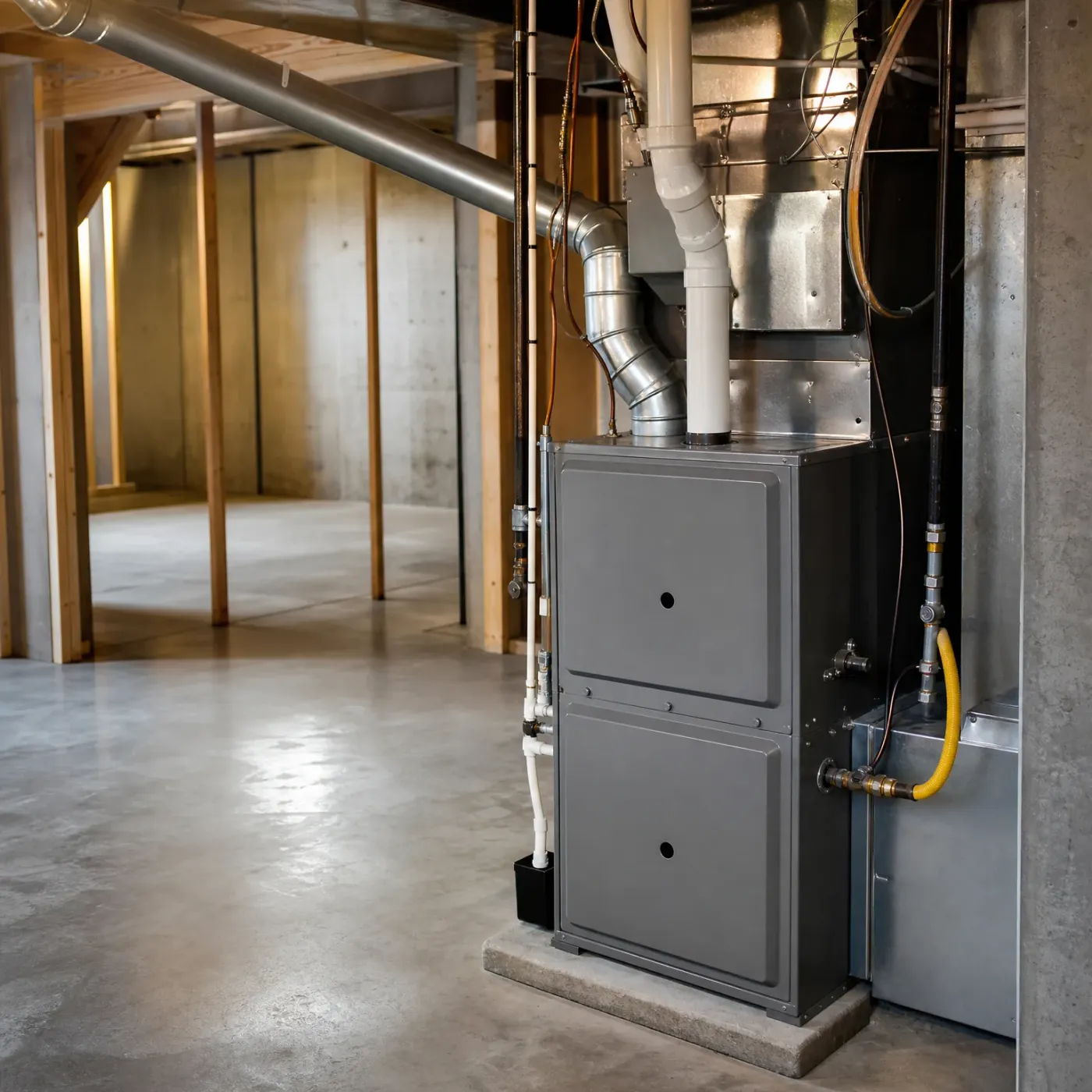
The white PVC pipes above your furnace carry the condensate down to a drain or pump, a few ounces at a time, all winter. No puddle on the concrete, no drips off the unit. The furnace runs its cycle and shuts off dry.
A furnace leaking water almost always means it's a high-efficiency condensing furnace, and the drain line or condensate pump that carries off its exhaust water has clogged, cracked, or frozen up somewhere along the line. These furnaces cool their exhaust enough to pull water out of it, and that water has to go somewhere. If the drain trap or the PVC line running to it gets blocked with algae or sediment, the water backs up and finds its way out of the unit instead. Low heating costs here mean most Arkansas homes run their furnace less overall, with electric heat common in many houses, but any furnace that burns gas and vents through PVC pipe can develop this same drain problem. Left alone, that water can rust out the heat exchanger or trip a safety switch that shuts the furnace down entirely, leaving you without heat on a cold night.

The white PVC pipes above your furnace carry the condensate down to a drain or pump, a few ounces at a time, all winter. No puddle on the concrete, no drips off the unit. The furnace runs its cycle and shuts off dry.

Dust sticks to a wet floor around an older furnace like this. If the drain line is cracked or the trap is clogged, water backs up and finds the lowest point instead of the drain. Left alone, it reaches the burner compartment or the electrical connections underneath.

A high-efficiency furnace pulls so much heat out of its exhaust that the leftover gas turns back into liquid. That water has to go somewhere, so the furnace routes it through a trap and down a drain line, same as a sink. A standard furnace vents its exhaust out hot through metal pipe. If yours drips, it's the condensing kind, and the water is exhaust byproduct, not a leak in the heat exchanger.

The condensate is slightly acidic, and over a winter it leaves behind a buildup inside the drain line, the same way hard water leaves scale in a kettle. That buildup narrows the pipe until water backs up faster than it can drain, and it finds the lowest open spot, usually the floor under the furnace. A trap that sits unused all summer can dry out too, which lets exhaust gas push water out instead of down.
A puddle on the concrete near the unit, or a drip you can hear hitting the floor pan during a cycle. Sometimes it's a musty smell in the closet or utility room before you ever see water. If the furnace has an error light blinking or it won't fire at all, the float switch in the condensate line has likely done its job and shut things down to keep water from reaching the electronics underneath. Left alone, that water finds the circuit board or the gas valve, and a clogged drain line turns into a furnace that won't run at all. With electric heat common in Arkansas homes, a furnace problem this time of year isn't background noise. It's the only thing standing between you and a cold house.


One form replaces the calls you'd make to find a furnace pro.
Send it once and finding someone is no longer on you.
You're not committing to anything by asking.


Exhaust gas cools inside the heat exchanger until it turns back to water.
That water drips down into a plastic trap built onto the furnace.
The trap feeds a drain line running to a floor drain or pump.
A clog, crack, or freeze-up anywhere in that path backs water up.




The puddle comes back every cycle and can reach the burners or blower. You're still searching for a tech, calling around, explaining the leak again each time.
Send the form once and skip the calling around. A tech clears the clog or swaps the part, and the furnace runs dry again.



The PVC flue pipe and drain line run straight and tight, carrying exhaust water out to a drain without a drip. Gas line, ducts, and piping all sit clean and dry on the concrete below. The furnace fires, runs its cycle, and shuts off with nothing pooling underneath.

Water sitting on the concrete floor under the unit, maybe tracking toward the gas pipes or the flexible conduit on the wall. The drain path has backed up somewhere between the furnace and the floor. Left alone, that water finds its way to parts that aren't built to sit in it.
Those cold nights are when the furnace runs long and steady, and that's when a condensate drain actually has water moving through it to clog or freeze. A furnace that leaks on a mild evening will often leak worse once the temperature drops toward freezing overnight.
NOAA nClimDiv 1991-2020 county normals weighted by homes
A furnace that leaks water is almost never a sign the unit is failing. It's a drain line, a trap, or a pump that's clogged, cracked, or iced up, and that's a part a tech can clear or replace. Arkansas winters are short, and most homes here run on electric heat anyway, so this furnace only has to get through a handful of hard-freeze nights where it runs long enough to push real water through that line. That's when a small clog turns into a puddle you can't ignore. Left alone, the water doesn't stay put. It can reach the burners or the blower, and what started as a wet spot on the concrete turns into a bigger repair. Nothing about this means the furnace is done. It means one part along the drain path needs attention, and most of the time that's a same-visit fix.
The part that actually takes effort is finding someone who can look at it. That usually means searching for a tech who works on this type of furnace, calling a few places to see who can come out, and explaining the same puddle and the same smell to each one before you even get a quote. Sending the form once ends that part. You explain it a single time, and the work of finding someone who knows this furnace and this problem stops being something you have to manage. The furnace is telling you something specific. A tech can confirm it fast and tell you exactly which part is behind it.





Answer a few questions instead of calling shop after shop.
No charge to send it. You decide if you hire them.