Tell us about the job
Takes about a minute. No obligation.
The burner, heat exchanger, and ignition system in a furnace here cycle hard every November through March, and that load compounds year over year. Homes in Saline County, AR run heat about five months a year, from November through March. Each firing cycle stresses the igniter and the heat exchanger in ways that add up slowly, so by the time a furnace throws a fault, those parts have already logged serious wear. A contractor diagnosing a repair in Saline County checks the igniter condition and heat exchanger integrity first, because that is where the season's work shows up.
Furnace parts that were standard when a house was built are not always still manufactured, and that gap is where repair work in Saline County gets complicated. Half the homes in Saline County, Arkansas were built in 1997 or earlier (2020-2024 ACS 5-year). A contractor who opens a furnace and identifies the failed component still has to establish whether a replacement is available new, sourced from a parts distributor, or no longer made at all. That answer changes what gets ordered, how long the repair takes, and sometimes whether the repair is viable.
The Parts of a Furnace a Contractor Checks First
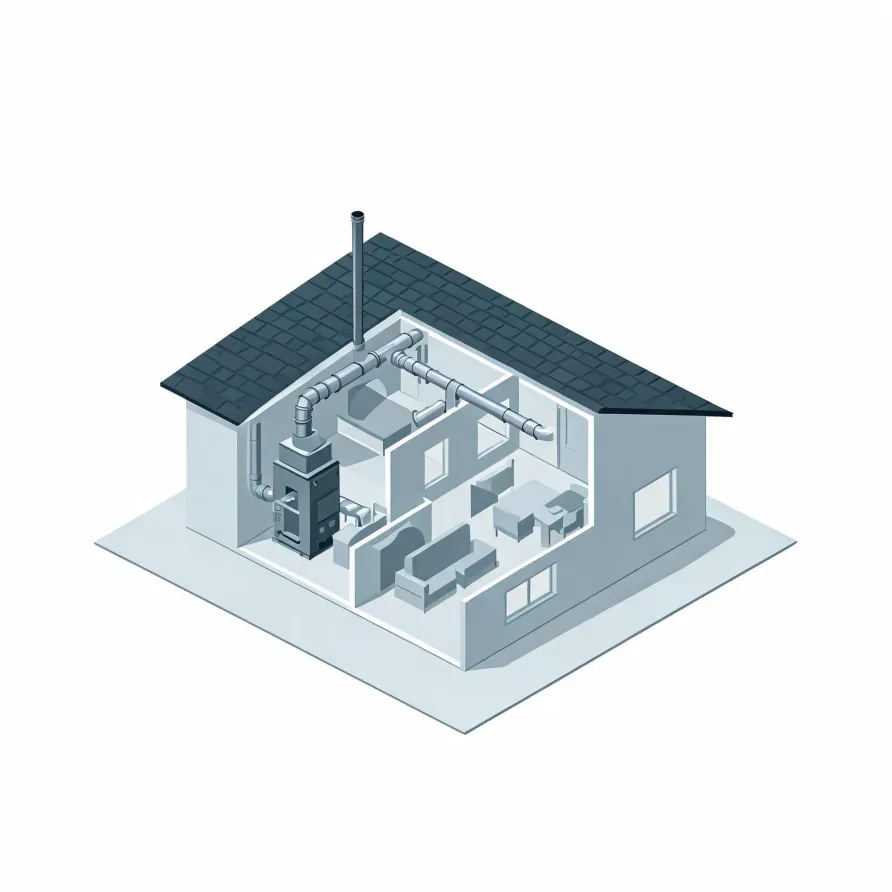
The furnace cabinet sits in a mechanical room, basement, or utility closet and is where the heat gets made. Inside it, the heat exchanger is the piece a contractor looks at closely when a homeowner reports strange smells or uneven heat, because a crack there affects both performance and safety. The burners, which fire beneath the heat exchanger, are another early stop when the furnace runs poorly or refuses to light.
The blower motor sits at the base of the cabinet and pushes conditioned air out through the supply side of the house. The flue pipe runs from the cabinet up and out of the structure, carrying combustion gases away. The control board ties these components together, and when behavior is erratic or the system short-cycles, a contractor checks it alongside the thermostat wiring that tells the whole system when to run.
The drawing shows a typical furnace layout, and a licensed contractor determines which components apply to the specific equipment and configuration in your home.
Find a contractor in Saline CountySaline County, Arkansas, by the numbers
155 severe weather events were recorded in Saline County, Arkansas between 2015 and 2024.
NOAA National Centers for Environmental Information, Storm Events Database, bulk CSV export, events 2015-01-01 through 2024-12-31.Half the homes in Saline County, Arkansas were built in 1997 or earlier (2020-2024 ACS 5-year).
U.S. Census Bureau, 2020-2024 American Community Survey 5-Year EstimatesSaline County, Arkansas holds 52,934 housing units (2020-2024 ACS 5-year).
U.S. Census Bureau, 2020-2024 American Community Survey 5-Year EstimatesOwners occupy 78.2% of the occupied homes in Saline County, Arkansas (2020-2024 ACS 5-year).
U.S. Census Bureau, 2020-2024 American Community Survey 5-Year EstimatesCodes & Standards Covering Furnace Repair in Saline County, Arkansas6 sourced rules and standards
What HVAC Repair Looks Like in Saline County
Non-weatherized gas furnaces manufactured on or after November 19, 2015 must reach 80.0 percent AFUE.
Non-weatherized oil-fired furnaces manufactured on or after November 19, 2015 must reach 83.0 percent AFUE.
Mobile home gas furnaces manufactured on or after November 19, 2015 must reach 80.0 percent AFUE.
Non-weatherized gas furnaces manufactured on or after December 18, 2028 must reach 95.0 percent AFUE, up from the 80.0 percent minimum that applies to units manufactured before that date.
Licensing and Legal Requirements in Saline County, Arkansas
An Arkansas HVACR licence is good across the state: no city or county may require its own licence to do HVACR work, though local permits and inspections still apply.
Arkansas requires an HVACR licence or registration: it is unlawful to do HVACR work without the appropriate one unless the chapter exempts you.
Severe Weather Events in Saline County
Weather puts hours on HVAC equipment. Hard runs, sudden demands, and prolonged stress all shorten the life of a furnace, and Saline County's climate drives that pattern in ways that show up directly in repair frequency.
155 severe weather events, 2015–2024. Source: NOAA National Centers for Environmental Information, Storm Events Database.