Tell us about the job
Takes about a minute. No obligation.
Burner assemblies and ignition components carry most of the load a furnace puts on itself, and in Monroe County that load arrives on a reliable schedule. Homes in Monroe County, AR run heat about five months a year, from November through March. The igniter cycles every time the burner fires, the heat exchanger expands and contracts with each run, and by late winter those parts have logged the kind of repetition that surfaces cracks, carbon buildup, and weakened contacts. A contractor repairing a furnace here checks the ignition system and heat exchanger first, because that is where the season's work shows up.
Furnace repair in housing stock this old tends to uncover layered histories inside the cabinet: a heat exchanger from one service call, a control board from another, a blower assembly that predates both. Half the homes in Monroe County, Arkansas were built in 1976 or earlier (2020-2024 ACS 5-year). What that means for a repair is that the contractor opening the unit is not looking at a coherent system but at whatever survived the last few decisions. Some of those parts are still available; some require sourcing from suppliers who specialize in discontinued lines. The age of the house sets the stage, but it is the patchwork inside the furnace that decides the scope.
The Parts of a Furnace a Contractor Checks First
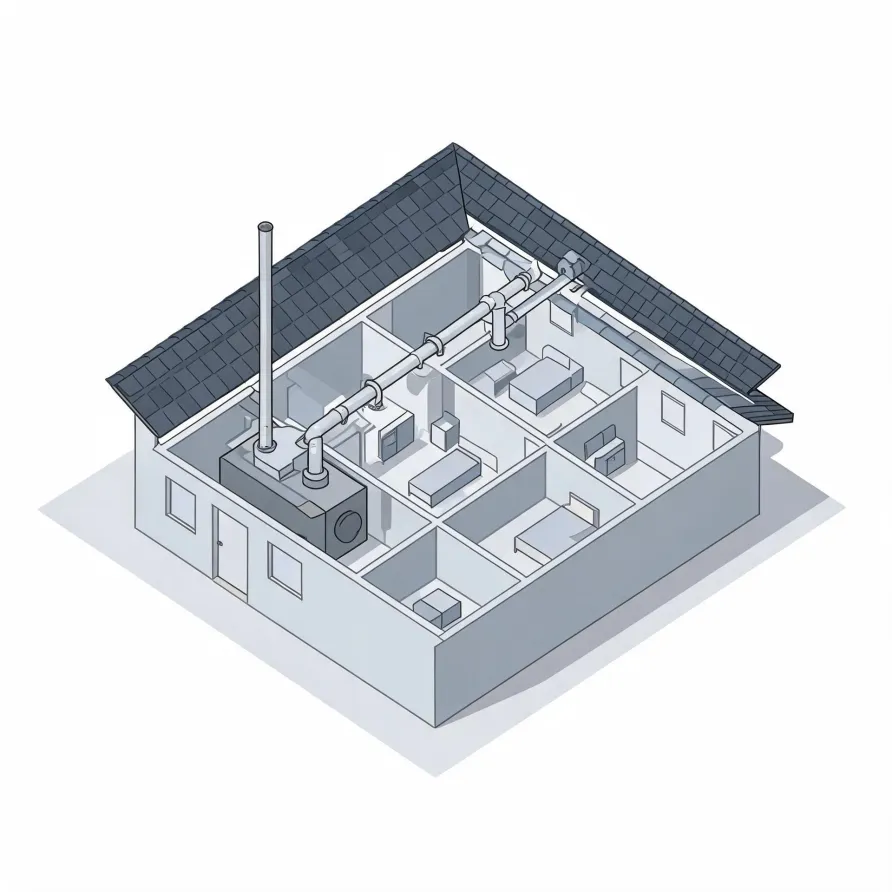
The furnace cabinet sits in a utility space, basement, or closet and is where heat is actually made. Inside it, the heat exchanger is the piece a contractor looks at closely during a repair call. Cracks or failures there affect both performance and safety. The burners, which fire beneath the exchanger, are another common starting point when heat output has dropped or the unit fails to start.
The blower motor sits at the base of the cabinet and moves conditioned air into the supply side of the duct system. The flue or vent pipe runs from the cabinet to an exterior wall or roof and carries combustion gases out of the house. The control board ties everything together, and when symptoms are scattered or unpredictable, a contractor will pull diagnostic codes from it early in the inspection.
The drawing shows the general layout of a furnace system, and a licensed contractor determines which components apply and what condition they are in for your specific house.
Find a contractor in Monroe CountyMonroe County, Arkansas, by the numbers
34 severe weather events were recorded in Monroe County, Arkansas between 2015 and 2024.
NOAA National Centers for Environmental Information, Storm Events Database, bulk CSV export, events 2015-01-01 through 2024-12-31.Half the homes in Monroe County, Arkansas were built in 1976 or earlier (2020-2024 ACS 5-year).
U.S. Census Bureau, 2020-2024 American Community Survey 5-Year EstimatesMonroe County, Arkansas holds 3,829 housing units (2020-2024 ACS 5-year).
U.S. Census Bureau, 2020-2024 American Community Survey 5-Year EstimatesOwners occupy 62.6% of the occupied homes in Monroe County, Arkansas (2020-2024 ACS 5-year).
U.S. Census Bureau, 2020-2024 American Community Survey 5-Year EstimatesCodes & Standards Governing Furnace Repair in Monroe County, Arkansas6 sourced rules & standards
What the Repair Visit Looks Like
Non-weatherized gas furnaces manufactured on or after November 19, 2015 must reach 80.0 percent AFUE.
Non-weatherized oil-fired furnaces manufactured on or after November 19, 2015 must reach 83.0 percent AFUE.
Mobile home gas furnaces manufactured on or after November 19, 2015 must reach 80.0 percent AFUE.
Non-weatherized gas furnaces manufactured on or after December 18, 2028 must reach 95.0 percent AFUE, up from the 80.0 percent minimum that applies to units manufactured before that date.
Licensing Rules for HVAC Work in Monroe County, Arkansas
An Arkansas HVACR licence is good across the state: no city or county may require its own licence to do HVACR work, though local permits and inspections still apply.
Arkansas requires an HVACR licence or registration: it is unlawful to do HVACR work without the appropriate one unless the chapter exempts you.
Weather That Works Against Equipment in Monroe County
Heating systems in this part of Arkansas take on more stress when the weather turns hard. How often that happens here shapes how much repair work local furnaces actually see.
34 severe weather events, 2015–2024. Source: NOAA National Centers for Environmental Information, Storm Events Database.