Tell us about the job
Takes about a minute. No obligation.
The burner and heat exchanger in a Marion County furnace cycle hard through a long stretch of the calendar. Homes in Marion County, AR run heat about seven months a year, from October through April. By the time a system shows a fault, the ignition components and heat exchanger have already logged the kind of accumulated starts that push metal fatigue and crack risk into real territory. A contractor arriving on a repair call here checks those parts first, because that is where the load lands year after year.
Furnace repair in Marion County starts with what comes apart. Half the homes in Marion County, Arkansas were built in 1986 or earlier (2020-2024 ACS 5-year). A house that old was heated by something entirely different for much of its life, and the furnace now inside it is a later addition, which means a contractor opening the heat exchanger or pulling the gas valve is working with components that have their own age, their own wear pattern, and their own parts chain. If a part is discontinued, the repair scope shifts before a quote can be written.
The Parts of a Furnace a Contractor Checks First
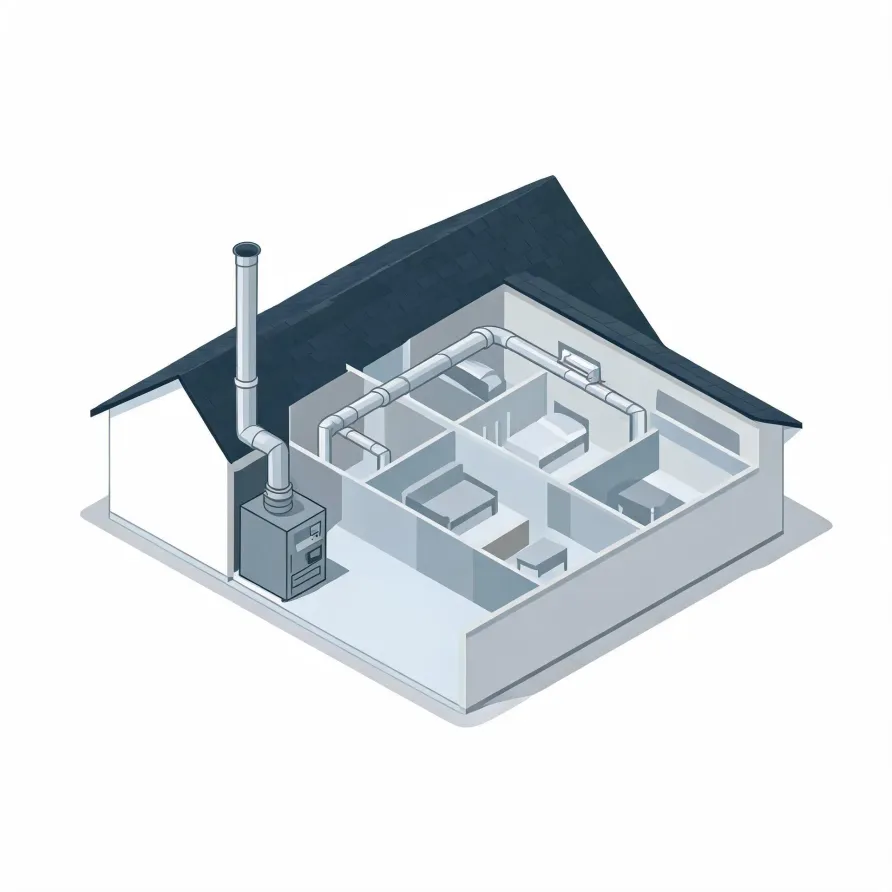
The furnace itself sits in a utility space, basement, or closet and is the piece that produces heat. Inside it, the heat exchanger is what a contractor looks at closely when a homeowner reports strange smells or uneven warmth, because a crack there changes everything. The burners, which fire inside that exchanger, are another early stop when the furnace runs poorly or not at all.
The blower motor lives inside the furnace cabinet and pushes conditioned air into the supply side of the house. Alongside it, the flue or exhaust vent runs from the cabinet to the outside and carries combustion gases away. The thermostat, mounted on a wall in the living space, is where a contractor often starts, since a wiring fault or failed sensor there can mimic a much larger problem.
The drawing shows a typical layout, and a licensed contractor will determine which components and conditions apply to your specific house.
Find a contractor in Marion CountyMarion County by the numbers
67 severe weather events were recorded in Marion County, Arkansas between 2015 and 2024.
NOAA National Centers for Environmental Information, Storm Events Database, bulk CSV export, events 2015-01-01 through 2024-12-31.Half the homes in Marion County, Arkansas were built in 1986 or earlier (2020-2024 ACS 5-year).
U.S. Census Bureau, 2020-2024 American Community Survey 5-Year EstimatesMarion County, Arkansas holds 9,749 housing units (2020-2024 ACS 5-year).
U.S. Census Bureau, 2020-2024 American Community Survey 5-Year EstimatesOwners occupy 81.3% of the occupied homes in Marion County, Arkansas (2020-2024 ACS 5-year).
U.S. Census Bureau, 2020-2024 American Community Survey 5-Year EstimatesRules & Standards Governing Furnace Repair in Marion County, Arkansas6 sourced rules and standards
What the repair visit looks like
Non-weatherized gas furnaces manufactured on or after November 19, 2015 must reach 80.0 percent AFUE.
Non-weatherized oil-fired furnaces manufactured on or after November 19, 2015 must reach 83.0 percent AFUE.
Mobile home gas furnaces manufactured on or after November 19, 2015 must reach 80.0 percent AFUE.
Non-weatherized gas furnaces manufactured on or after December 18, 2028 must reach 95.0 percent AFUE, up from the 80.0 percent minimum that applies to units manufactured before that date.
Licensing Rules for HVAC Work in Marion County, Arkansas
An Arkansas HVACR licence is good across the state: no city or county may require its own licence to do HVACR work, though local permits and inspections still apply.
Arkansas requires an HVACR licence or registration: it is unlawful to do HVACR work without the appropriate one unless the chapter exempts you.
Severe Weather Events in Marion County
Hard weather puts real hours on heating equipment. Furnaces that cycle hard through storm seasons wear faster, and repair needs in Marion County reflect what the local climate actually delivers.
67 severe weather events, 2015–2024. Source: NOAA National Centers for Environmental Information, Storm Events Database.