Tell us about the job
Takes about a minute. No obligation.
A furnace repair in Boone County starts with what the burner and ignition system have already been through. Homes in Boone County, AR run heat about seven months a year, from October through April. Cycling on and off across that many months stresses the heat exchanger and wears the igniter faster than most homeowners expect. A contractor will check those parts first, because that is where fatigue shows up on a system that has been carrying a full heating load year after year. Ductwork connections and the blower motor follow close behind.
Furnace parts availability is the variable that most often changes the scope and the price of a repair in Boone County. Half the homes in Boone County, Arkansas were built in 1985 or earlier (2020-2024 ACS 5-year). A system running in housing that old was likely installed as a replacement, which means the furnace itself may be a generation or two behind current production runs. When a contractor opens the unit, the question is whether the heat exchanger, control board, or igniter it takes still moves through supply chains or has to be sourced as old stock. If the part is no longer in regular production, the repair bill and the timeline both shift.
The Parts of a Furnace a Contractor Checks First
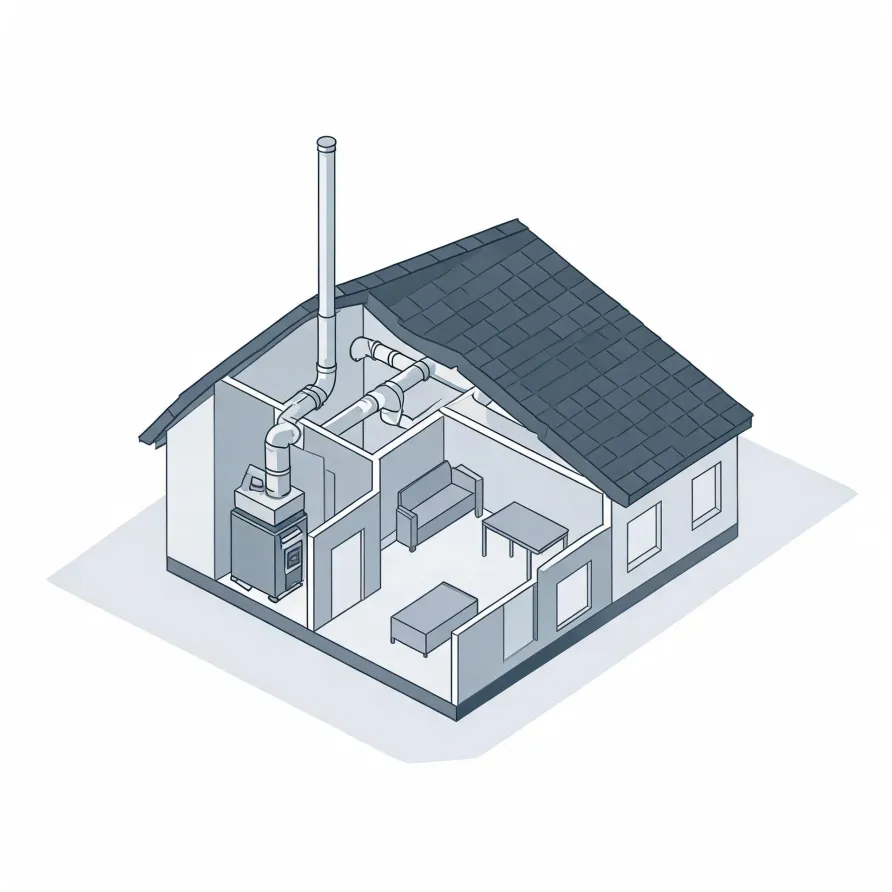
The furnace itself sits in the basement, utility room, or crawl space and is the piece a contractor goes to first. Inside it, the heat exchanger is the part most worth understanding: a crack there lets combustion gases into the air supply, so a contractor checks it closely. The burners, which fire the heat exchanger, are another early stop when the system is running poorly or not at all.
The blower motor sits inside the furnace cabinet and pushes conditioned air through the house. The flue pipe runs from the cabinet up and out of the house, carrying combustion exhaust away. The thermostat, mounted on a wall in the living space, is where a contractor often starts before opening the cabinet at all.
The drawing shows a typical layout, and a licensed contractor will assess which parts apply and what condition they are in for your specific home.
Find a contractor in Boone CountyBoone County, Arkansas, by the numbers
90 severe weather events were recorded in Boone County, Arkansas between 2015 and 2024.
NOAA National Centers for Environmental Information, Storm Events Database, bulk CSV export, events 2015-01-01 through 2024-12-31.Half the homes in Boone County, Arkansas were built in 1985 or earlier (2020-2024 ACS 5-year).
U.S. Census Bureau, 2020-2024 American Community Survey 5-Year EstimatesBoone County, Arkansas holds 17,459 housing units (2020-2024 ACS 5-year).
U.S. Census Bureau, 2020-2024 American Community Survey 5-Year EstimatesOwners occupy 70.8% of the occupied homes in Boone County, Arkansas (2020-2024 ACS 5-year).
U.S. Census Bureau, 2020-2024 American Community Survey 5-Year EstimatesFurnace Repair Rules on Record for Boone County, Arkansas6 codes, standards & laws
What the repair visit looks like
Non-weatherized gas furnaces manufactured on or after November 19, 2015 must reach 80.0 percent AFUE.
Non-weatherized oil-fired furnaces manufactured on or after November 19, 2015 must reach 83.0 percent AFUE.
Mobile home gas furnaces manufactured on or after November 19, 2015 must reach 80.0 percent AFUE.
Non-weatherized gas furnaces manufactured on or after December 18, 2028 must reach 95.0 percent AFUE, up from the 80.0 percent minimum that applies to units manufactured before that date.
What Boone County, Arkansas Requires for HVAC Repair Work
An Arkansas HVACR licence is good across the state: no city or county may require its own licence to do HVACR work, though local permits and inspections still apply.
Arkansas requires an HVACR licence or registration: it is unlawful to do HVACR work without the appropriate one unless the chapter exempts you.
Severe Weather Events in Boone County
Furnaces in Boone County take on wear in direct proportion to how hard the weather pushes them. The repair picture here is shaped by local conditions, and the data below shows what those conditions have looked like year by year.
90 severe weather events, 2015–2024. Source: NOAA National Centers for Environmental Information, Storm Events Database.