Tell us about the job
Takes about a minute. No obligation.
A furnace repair in Columbia County starts with the parts that do the actual cycling: the burner, the heat exchanger, and the ignition system. Homes in Columbia County, AR run heat about five months a year, from November through March. Each heating cycle stresses the igniter and the burner assembly, and a system that has been running through that kind of season accumulates fatigue in those components well before the blower or the controls show trouble. A contractor who opens the unit looks at igniter condition and heat exchanger integrity first, because that is where the load lands.
Furnaces in older housing stock tend to outlast the supply chains built around them. Half the homes in Columbia County, Arkansas were built in 1981 or earlier (2020-2024 ACS 5-year). A system running in a house that age draws on parts that manufacturers have cycled through, revised, or discontinued, which means a contractor opening the unit has to confirm what is actually inside before any order gets placed. The heat exchanger, the gas valve, the igniter assembly: what is there may be original, may be a prior repair, may be a mix. That determination shapes the scope of the job more than the fault code that sent someone out in the first place.
The Parts of a Furnace a Contractor Checks First
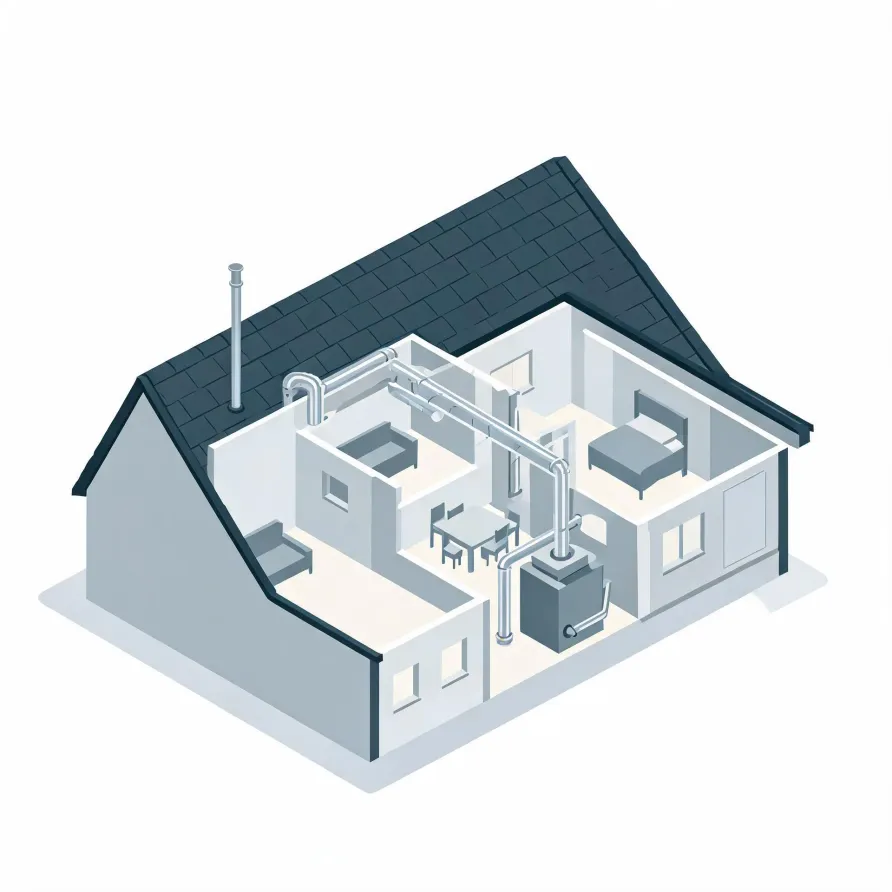
The furnace itself sits in a utility room, basement, or closet and is where heat is produced. Inside it, the heat exchanger is the piece a contractor looks at closely during a repair call, because cracks or failures there affect both heating and air quality. The burners feed it, and when ignition problems show up, the igniter and flame sensor are the first suspects.
The blower motor sits at the base of the furnace cabinet and pushes conditioned air into the supply side of the duct system. Alongside it, the control board coordinates every other component, so electrical faults or erratic behavior often trace back there. The flue pipe exits the cabinet and vents combustion gases out of the house, and damage or blockage there is something a contractor checks early.
The drawing shows a typical furnace layout, and a licensed contractor determines which components apply to your specific system and what work those components need.
Find a contractor in Columbia CountyColumbia County, Arkansas, by the numbers
79 severe weather events were recorded in Columbia County, Arkansas between 2015 and 2024.
NOAA National Centers for Environmental Information, Storm Events Database, bulk CSV export, events 2015-01-01 through 2024-12-31.Half the homes in Columbia County, Arkansas were built in 1981 or earlier (2020-2024 ACS 5-year).
U.S. Census Bureau, 2020-2024 American Community Survey 5-Year EstimatesColumbia County, Arkansas holds 11,030 housing units (2020-2024 ACS 5-year).
U.S. Census Bureau, 2020-2024 American Community Survey 5-Year EstimatesOwners occupy 70.7% of the occupied homes in Columbia County, Arkansas (2020-2024 ACS 5-year).
U.S. Census Bureau, 2020-2024 American Community Survey 5-Year EstimatesFurnace Repair Rules on the Books for Columbia County, Arkansas6 sourced standards and codes
What HVAC Repair Actually Looks Like in Columbia County
Non-weatherized gas furnaces manufactured on or after November 19, 2015 must reach 80.0 percent AFUE.
Non-weatherized oil-fired furnaces manufactured on or after November 19, 2015 must reach 83.0 percent AFUE.
Mobile home gas furnaces manufactured on or after November 19, 2015 must reach 80.0 percent AFUE.
Non-weatherized gas furnaces manufactured on or after December 18, 2028 must reach 95.0 percent AFUE, up from the 80.0 percent minimum that applies to units manufactured before that date.
Licensing Rules for HVAC Repair in Columbia County, Arkansas
An Arkansas HVACR licence is good across the state: no city or county may require its own licence to do HVACR work, though local permits and inspections still apply.
Arkansas requires an HVACR licence or registration: it is unlawful to do HVACR work without the appropriate one unless the chapter exempts you.
Severe Weather Events in Columbia County
Extreme weather puts real stress on furnace systems, forcing them to run harder and longer than they were sized to handle. How often that happens here shapes what local equipment goes through and how soon it needs attention.
79 severe weather events, 2015–2024. Source: NOAA National Centers for Environmental Information, Storm Events Database.