Tell us about the job
Takes about a minute. No obligation.
A furnace repair in White County starts with the parts that do the actual work: the burner, the heat exchanger, and the ignition system. Homes in White County, AR run heat about six months a year, from November through April. Each of those components cycles on and off through every one of those months, and the wear that builds in the burner assembly and across the heat exchanger surface is what a contractor finds first when the system stops performing. A cracked heat exchanger or a fouled igniter is not a surprise on equipment that has been through that kind of accumulated cycling. The idle months that follow do not undo what the heating season puts on those parts.
Half the homes in White County, Arkansas were built in 1992 or earlier (2020-2024 ACS 5-year). A furnace that has been running in a house of this vintage has had time to accumulate heat exchanger fatigue, burner scaling, and draft issues that show nothing until the cabinet is open. A contractor working on a call here quotes a range until they see the interior, because what looks like a simple igniter swap can open into a cracked exchanger or a failed inducer motor. Parts availability is a live question too: components for equipment that old are not always stocked locally and sometimes require a search before the job can close.
The Parts of a Furnace a Contractor Checks First
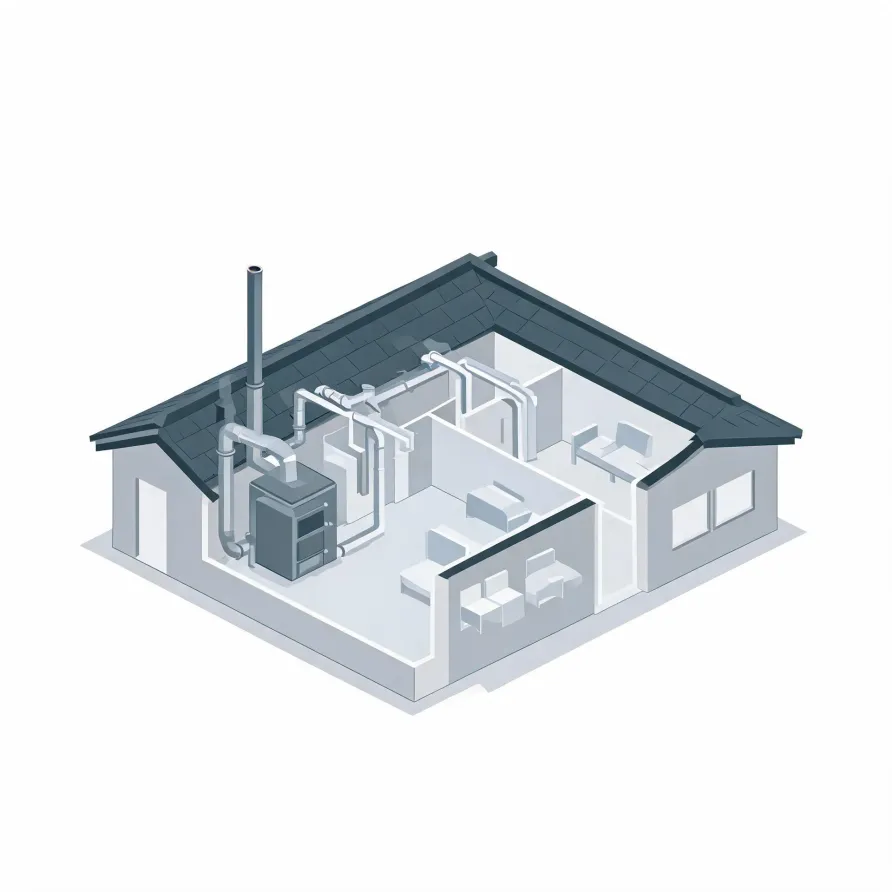
The furnace itself sits in a basement, utility closet, or crawlspace and is the piece most likely at the center of any repair call. Inside it, the heat exchanger is what a contractor looks at closely when a homeowner reports strange smells or uneven heat, because a crack there is serious. The burners, igniter, and flame sensor all sit within the furnace cabinet and are common sources of a no-heat call.
The blower motor lives inside the same cabinet and pushes conditioned air into the ducts. The flue pipe runs from the furnace to an exterior wall or roof and carries combustion gases out of the house. The thermostat on the wall is the first thing a contractor checks, because a wiring fault or failed sensor there can mimic a furnace problem.
The drawing shows a typical furnace layout, and a licensed contractor determines what applies to the specific equipment and configuration in your home.
Find a contractor in White CountyWhite County, Arkansas, by the numbers
107 severe weather events were recorded in White County, Arkansas between 2015 and 2024.
NOAA National Centers for Environmental Information, Storm Events Database, bulk CSV export, events 2015-01-01 through 2024-12-31.Half the homes in White County, Arkansas were built in 1992 or earlier (2020-2024 ACS 5-year).
U.S. Census Bureau, 2020-2024 American Community Survey 5-Year EstimatesWhite County, Arkansas holds 33,900 housing units (2020-2024 ACS 5-year).
U.S. Census Bureau, 2020-2024 American Community Survey 5-Year EstimatesOwners occupy 69.1% of the occupied homes in White County, Arkansas (2020-2024 ACS 5-year).
U.S. Census Bureau, 2020-2024 American Community Survey 5-Year EstimatesCodes & Standards Governing Furnace Repair in White County, Arkansas6 sourced rules & standards
What HVAC Repair Looks Like in White County
Non-weatherized gas furnaces manufactured on or after November 19, 2015 must reach 80.0 percent AFUE.
Non-weatherized oil-fired furnaces manufactured on or after November 19, 2015 must reach 83.0 percent AFUE.
Mobile home gas furnaces manufactured on or after November 19, 2015 must reach 80.0 percent AFUE.
Non-weatherized gas furnaces manufactured on or after December 18, 2028 must reach 95.0 percent AFUE, up from the 80.0 percent minimum that applies to units manufactured before that date.
Licensing and Legal Requirements in White County, Arkansas
An Arkansas HVACR licence is good across the state: no city or county may require its own licence to do HVACR work, though local permits and inspections still apply.
Arkansas requires an HVACR licence or registration: it is unlawful to do HVACR work without the appropriate one unless the chapter exempts you.
Severe Weather Events in White County
Extreme weather puts stress on furnaces that steady mild winters never would. How hard heating equipment works, and how often it needs repair, is shaped by what the local climate actually does.
107 severe weather events, 2015–2024. Source: NOAA National Centers for Environmental Information, Storm Events Database.